feat(evals): core journeys green on real infra, environment healing behind its components, timeline observability - #3359
Conversation


|
The latest updates on your projects. Learn more about Vercel for GitHub.
|


…come surface, no onboarding needed)
…ics name the interception

Core flows now proven on real infrastructureFive spec files pass against a fresh Daytona sandbox (each app spec spawns its own isolated Electron):
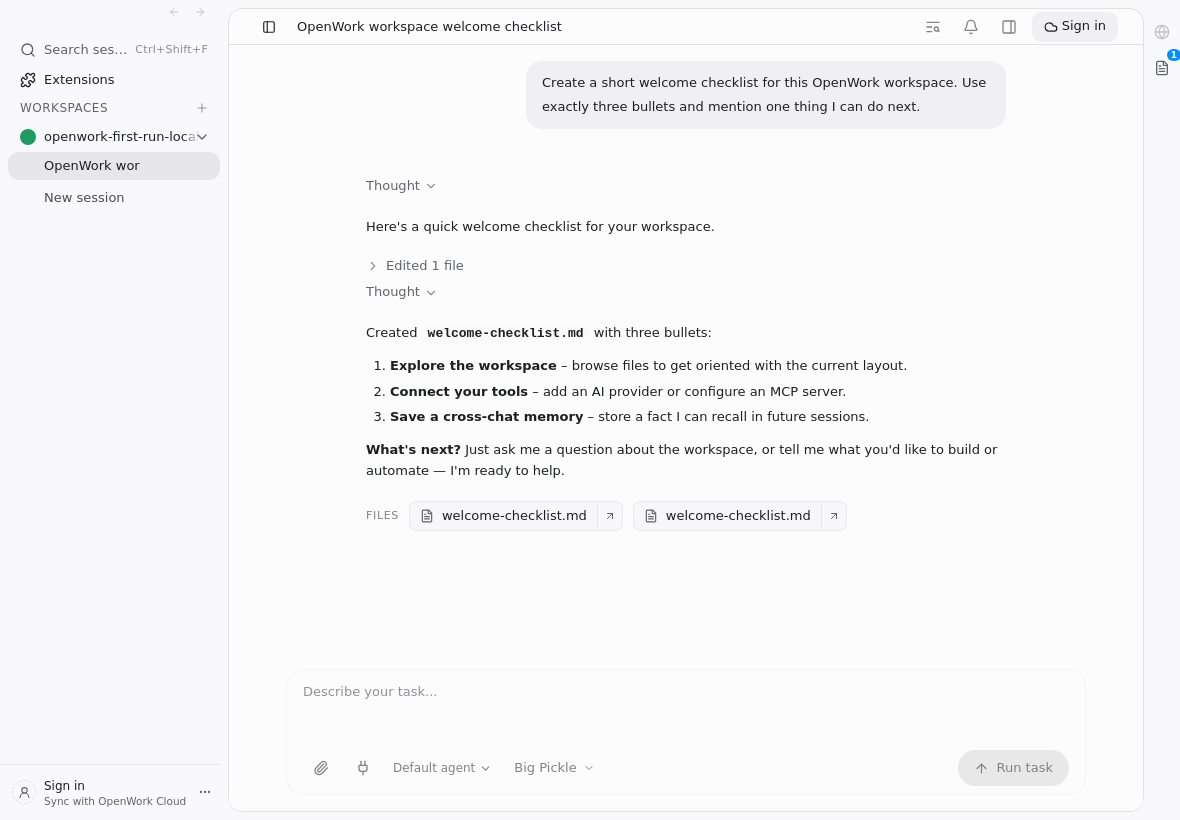
The first-run journey's final frame — the agent actually did the work: The fixes that got them greenEach came from a real failure, not a guess:
Environment fixes worth knowingIsolated Electron could not run in a container at all until: Still red
|
… skill via a marketplace
…own it

Target re-attach now lives in @openwork/cdp (evaluateOnSurface), display liveness
and stale-surface cleanup in @openwork/hosts (spawnElectron), and resolveHost no
longer picks the Daytona host when the caller is already inside a sandbox. The
sandbox runner scripts drop the logic they were carrying.
…eep link from the browser
Update: environment healing moved behind the components that own itThree things that had been fixed in shell scripts and behaviour retry loops are now the responsibility of the component whose job they actually are:
Plus a real bug this surfaced:
The refactor validated itself: after a sandbox restart the X server was dead, and all three app specs still passed — the host noticed and started the display, with no script involved. Effect on the suiteFull nightly run went from 4 passed / 7 failed → 7 passed / 4 failed. Still green after the move: New core journey: first run → browser sign-in → share a skill via a marketplaceAdded
Proven by running it: the app really does hand off to a browser — the shim captured Not green yet: Only the OS protocol dispatch of the deep link is bridged (a container registers no handler); the grant is the real one Den issued for that browser session, and that limitation is stated in the code. |
…path

seedWorkspace arranged a workspace over the local server API and left the
engine unconfigured and the model catalog empty — a state the product's own
onboarding never produces, so specs failed on arrangement instead of their
subject. Every spec now goes through createAndSelectWorkspace, the path the
passing journeys already proved.

Also read the created session id from the field session.list_sessions really
returns: items carry sessionId, not id (probed live; the old extraction never
matched, so the wait timed out even with sessions present).
…in code input

Probed live on a running den: auth is an email-only step (Next) that routes
to a password step (Sign in) — there is no single form and no sign-up/sign-in
toggle. After sign-in the deep link is not an anchor or page text; it is a
readonly input holding the openwork://den-auth?grant=… sign-in code next to
Open OpenWork, so read it from there.
…on profiles

Each surface's fresh HOME hides the host's pnpm tool cache, so the pinned
pnpm (packageManager) is re-downloaded from the network on every spawn
(21MB). On the eval sandbox one failed download degenerated into a
self-sustaining recursive 'pnpm add pnpm' cascade that outlived the run and
starved later spawns. Point PNPM_HOME at the host's real pnpm home; the
redirect is then local and instant (verified: fresh HOME resolves in 0.75s
with no downloads).
Exporting OPENWORK_EVAL_DEN_API_URL unconditionally made den-gated specs run
against nothing and die in 3ms with 'fetch failed' instead of skipping with
their own reason. Probe /health first; with OPENWORK_SPEC_NEEDS_DEN=1 the
stack is still ensured before the probe.
…shot

The skills menu is a scrollable list: /browser-automation was loaded (the
DOM assertions passed) while the screenshot showed only the rows above it,
so the visual validator honestly reported it absent.

The workspace engine boot blocks the renderer JS thread in bursts. Bare
20s evaluations (plug-menu clicks) died with raw CDP timeouts, and the
measure evaluations gave their outer CDP call the same 20s deadline as the
in-page poll, so the two raced under load. Fold the menu clicks into a
guarded, retried wait and give the measures headroom over their inner
deadlines.
…enshot

The capability menu is a scrollable popover: all four sections were in the
DOM (the code assertion passed) while Agents sat above the fold, so the
validator honestly reported it invisible. Scroll the named row into view and
let the code assertion carry section completeness.
… see

The vision loop caught a real product defect: with a long command list the
capability popover extends under the window header, so its first section row
(Agents) is covered and unclickable (repo workspace, popover top at y=17
under the title bar). Keep four-section completeness as the DOM assertion,
scope the visual claim to the visible sections, and record the defect where
the claim is made.
…u with retried waits

The scenario opened the plug menu inside its own evaluate with fixed
100/300ms delays right after a reload; under load those clicks land before
React handlers attach and the whole block times out. Arm the fetch delay and
the connect witness in one small mutation, open the menu with the guarded
retried helper, then measure.
…cloud skills

The scenario set window.__OPENWORK_GATEWAY__, which flips the app into the
hosted gateway runtime and rewires the local openwork-server client to the
page origin — so client.listSkills hit the Vite dev server and local skills
never rendered, a state no desktop user can reach. The den auth token and
active org id it also set are the real cloud-connected desktop arrangement,
so keep only those. Drop the unused resetSkillsCloudState.
…t be faithful

On desktop, den traffic goes through the main process, so the renderer
fetch hook never delayed anything (denRequestCount stayed 0), and the
gateway marker it used instead rewired the local server to the page origin.
The block therefore only ever measured an impossible state. Cloud latency
belongs in a den-boundary fault spec like app-den-tls-fault, where the
fault is injected for real.
…pace before sign-in

signInInBrowser returned right after clicking Sign in, so the next frame
honestly showed 'Working...'. Wait for the signed-in outcome (or the
sign-in code) before returning.

The signed-in org shell offers no Add workspace entry, and the
workspace.create control there reports ok while creating nothing (its error
lands in closed-modal state) — probed live twice. Arrange org specs the way
a member actually gets there: create the workspace on the proven welcome
path first, then sign in; organization onboarding is completed when it
appears and the existing workspace is reselected either way.
POST /v1/marketplaces/:id/access rejects a grant without role
(viewer|editor|manager). Viewer is what sharing with a colleague means.
…nents

The resolved marketplace payload carries plugins with component counts only;
skill names live on GET /v1/plugins/:id/resolved as items[].configObject
(objectType skill, title). Read them as the member so visibility stays the
colleague's, not the admin's.
… managed-recovery defect

The picker can paint 'No models' before the engine's catalog lands (observed
live: 0 models on first read, 7 shortly after on the same boot), so the
primary test polls up to 90s before asserting.

The managed test now pins today's truth: after an admin publishes a
provider, Retry does not deliver it to the composer even though the API
already entitles the member (probed live, 201 + readable as the member, empty
notice survives 90s+). The spec asserts the notice stays honest and the
composer stays usable; when live recovery ships, the pinned wait fails
loudly and the recovery assertions come back from history.
… a model)

With no selectable model the composer renders no contenteditable editor, so
the pinned block asserts what is really there: the persistent notice with
Retry and no crash.
…eads Refreshing mid-flight)

3 participants


What
Makes the migrated eval specs actually pass against a real app, and puts each environment concern behind the component that owns it. Three core user journeys are now green on real infrastructure, and a fourth (cloud sharing) is most of the way there.
Core journeys proven on a fresh Daytona sandbox
first-run-localwelcome-checklist.md); 7 frames, 15/15 vision expectationsapp-den-tls-faultapp-smokeegress-tls12-only/egress-selective-denyComplexity behind the component that owns it
reattachSurfacein behaviour retry loops@openwork/cdp→evaluateOnSurface()xdpyinfodisplay check in two shell scripts@openwork/hosts→spawnElectron()pkillof stale Electrons in shell@openwork/hosts, scoped to its own surfaces rootresolveHost()also no longer picks the Daytona host while running inside a sandbox (the CLI indirection cannot work there) — that bug was why nothing spawned and readiness ran against an empty page.scripts/evals/daytona-spec.shis back to 36 lines.It validated itself: after a sandbox restart the X server was dead and all three app specs still passed, because the host noticed and started the display.
Observability
@openwork/timelinerecords the composable functions every spec funnels through (app.readiness,validatewith cache hit/miss,seed.workspace, cloud calls), so results show where time goes without specs mentioning timing. Vitest only reports per-file/per-test duration, which says nothing about which beat was slow in a 112-second journey.Correctness fixes that came from real failures
openwork.react.activeWorkspace/session.list_sessions; several waits were asserting routes the app never produces.no-workspace, settings/extensions. Background copy like "Preparing workspace" no longer makes the welcome screen count as not-ready.\/collapses in template literals) and a skill-name parser that returned the whole row.SuppressedErrorstops masking real assertion failures.Honest visual expectations
Vision caught three defects DOM checks missed, and each fix corrected the spec, not the guard: a false claim (duplicate pixels behind a picker that was never opened), a premature assertion ("only 'Preparing workspace' is visible"), and a DOM/pixel divergence where the control API reported a task control enabled while the button was visibly gray.
New: first run → browser sign-in → share a skill (not green yet)
first-run-cloud-share.slow.test.tspluscaptureOpenedUrls()(PATH shim overxdg-open, so the browser handoff is observed rather than assumed),signInInBrowser(),readHandoffDeepLink(), andcloud-plugins.tsagainst the real Den contract —createPluginWithSkillusescomponents+marketplaceId, andreadResolvedMarketplacereads as the colleague.Proven: the app really hands off to a browser (
…/?mode=sign-up&desktopAuth=1&desktopScheme=openwork), Den comes up, Chrome loads the auth form. Blocked on Den web's sign-in shape (email-then-password rather than one form). Only the OS protocol dispatch ofopenwork://den-auth?grant=…is bridged — a container registers no handler — and the code says so.Tests run
pnpm evals:typecheckclean ·pnpm --dir evals run test95/95 ·pnpm --dir evals run spec4/4 (the gatingprlane) · full nightly run on a real sandbox went 4 passed / 7 failed → 7 passed / 4 failed.Still red:
skills-local,models-available,org-connection-lifecycle,first-run-cloud-share. Nothing gates on them — theprlane gates, app specs are nightly-only, opt-in viaOPENWORK_EVAL_APP_SPECS=1, and that step iscontinue-on-errorwhile they stabilise.