NanoXLSX is a small .NET library written in C#, to create and read Microsoft Excel files in the XLSX format (Microsoft Excel 2007 or newer) in an easy and native way
- ✅ Minimum of dependencies (*
- ❌ No need for an installation of Microsoft Office
- ❌ No need for Office interop libraries
- ❌ No need for proprietary 3rd party libraries
- ❌ No need for an installation of the Microsoft Open Office XML SDK (OOXML)
🌐 Project website: https://picoxlsx.rabanti.ch
📄 See the Change Log for recent updates.
NanoXLSX v3 is split into modular NuGet packages:
| Module | Status | Description |
|---|---|---|
| NanoXLSX.Core | 🟢 Mandatory, Bundled | Core library with workbooks, worksheets, cells, styles. No external dependencies |
| NanoXLSX.Reader | 🔵 Optional, Bundled | Extension methods to read/load XLSX files. Depends on Core |
| NanoXLSX.Writer | 🔵 Optional, Bundled | Extension methods to write/save XLSX files. Depends on Core |
| NanoXLSX.Formatting | 🔵 Optional, Bundled | In-line cell formatting (rich text). External repo. Depends on Core |
| NanoXLSX | ⭐ Meta-Package | Bundles all of the above. Recommended for most users |
Note: All bundled modules are included when you install the
NanoXLSXmeta-package. There are currently no non-bundled (standalone) modules.
For advanced scenarios, you can install only the specific packages you need (e.g. NanoXLSX.Core + NanoXLSX.Writer for write-only applications).
NanoXLSX v3 is a major release with significant architectural changes:
- Modular architecture - Split into separate NuGet packages (Core, Reader, Writer, Formatting) with a plugin system
- New Color system - Unified
Colorclass supporting RGB, ARGB, indexed, theme and system colors - Redesigned Font and Fill - Font properties now use proper enums; Fill supports flexible color definitions with tint
- PascalCase naming - All enums and constants follow C# naming conventions
- Immutable value types -
AddressandRangestructs are now immutable - In-line formatting - Rich text cell formatting via the NanoXLSX.Formatting module
- Utils reorganization -
Utilsclass split intoDataUtils,ParserUtils,Validators
NanoXLSX v3.x is planned as the long-term supported version. Possible future enhancements include:
- 🔒 Modern password handling (e.g. SHA-256 for worksheet protection)
- 🎨 Auto-formatting capabilities
- 🔢 Formula assistant for easier formula creation
- 🖌️ Modern Style builder API
- 💬 Support for cell comments
- 🖼️ Embedded images and charts
- 🚀 Performance optimizations
The reader of NanoXLSX follows the principle of "What You Can Write Is What You Can Read". Therefore, all information about workbooks, worksheets, cells and styles that can be written into an XLSX file by NanoXLSX, can also be read by it. There are some limitations:
- A workbook or worksheet password cannot be recovered, only its hash
- Information that is not supported by the library will be discarded
- There are some approximations for floating point numbers. These values (e.g. pane split widths) may deviate from the originally written values
- Numeric values are cast to the appropriate .NET types with best effort. There are import options available to enforce specific types
- No support of other objects than spreadsheet data at the moment
- Due to the potential high complexity, custom number format codes are currently not automatically escaped on writing or un-escaped on reading
NanoXLSX is originally based on PicoXLSX. However, NanoXLSX is now in the development lead, whereas PicoXLSX is a subset of it. The library is currently on compatibility level with .NET version 4.5 and .NET Standard 2.0. Newer versions should of course work as well. Older versions, like .NET 3.5 have only limited support, since newer language features were used.
*)The only requirement to compile the library besides .NET (v4.5 or newer) is the assembly WindowsBase, as well as System.IO.Compression. These assemblies are standard components in all Microsoft Windows systems (except Windows RT systems). If your IDE of choice supports referencing assemblies from the Global Assembly Cache (GAC) of Windows, select WindowsBase and Compression from there. If you want so select the DLLs manually and Microsoft Visual Studio is installed on your system, the DLL of WindowsBase can be found most likely under "c:\Program Files\Reference Assemblies\Microsoft\Framework\v3.0\WindowsBase.dll", as well as System.IO.Compression under "c:\Program Files (x86)\Reference Assemblies\Microsoft\Framework.NETFramework\v4.5\System.IO.Compression.dll". Otherwise you find them in the GAC, under "c:\Windows\Microsoft.NET\assembly\GAC_MSIL\WindowsBase" and "c:\Windows\Microsoft.NET\assembly\GAC_MSIL\System.IO.Compression"
The NuGet package does not require dependencies
.NET Standard v2.0 resolves the dependency System.IO.Compression automatically, using NuGet and does not rely anymore on WindowsBase in the development environment. In contrast to the .NET >=4.5 version, no manually added dependencies necessary (as assembly references) to compile the library.
The Test project and GitHub Actions may also require dependencies like unit testing frameworks or workflow steps. However, none of these dependencies are essential to build the library. They are just utilities. The test dependencies ensure efficient unit testing and code coverage. The GitHub Actions dependencies are used for the automatization of releases and API documentation
By package Manager (PM):
Install-Package NanoXLSXBy .NET CLI:
dotnet add package NanoXLSXℹ️ Note: Other methods like adding DLLs or source files directly into your project are technically still possible, but not recommended anymore. Use dependency management, whenever possible
 Workbook workbook = new Workbook("myWorkbook.xlsx", "Sheet1");         // Create new workbook with a worksheet called Sheet1
 workbook.WS.Value("Some Data");                                        // Add cell A1
 workbook.WS.Formula("=A1");                                            // Add formula to cell B1
 workbook.WS.Down();                                                    // Go to row 2
 workbook.WS.Value(DateTime.Now, Style.BasicStyles.Bold);               // Add formatted value to cell A2
workbook.Save(); // Save the workbook as myWorkbook.xlsx Workbook workbook = new Workbook("myWorkbook.xlsx", "Sheet1"); // Create new workbook with a worksheet called Sheet1
workbook.CurrentWorksheet.AddNextCell("Some Data"); // Add cell A1
workbook.CurrentWorksheet.AddNextCell(42); // Add cell B1
workbook.CurrentWorksheet.GoToNextRow(); // Go to row 2
workbook.CurrentWorksheet.AddNextCell(DateTime.Now); // Add cell A2
workbook.Save(); // Save the workbook as myWorkbook.xlsx using NanoXLSX.Extensions;
Workbook wb = WorkbookReader.Load("basic.xlsx"); // Read the workbook
System.Console.WriteLine("contains worksheet name: " + wb.CurrentWorksheet.SheetName);
foreach (KeyValuePair<string, Cell> cell in wb.CurrentWorksheet.Cells)
{
System.Console.WriteLine("Cell address: " + cell.Key + ": content:'" + cell.Value.Value + "'");
}See the full API-Documentation at: https://rabanti-github.github.io/NanoXLSX/.
The Demo Project contains 27 examples covering various use cases. The demo project is maintained in a separate repository. See the section NanoXLSX for the specific examples related to NanoXLSX.
See also: Getting started in the Wiki
Hint: You will find most certainly any function, and the way how to use it, in the Unit Test Project
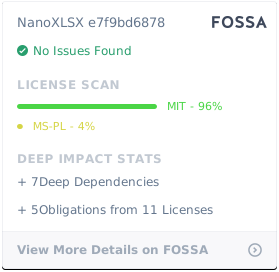
NanoXLSX is licensed under the MIT License. See the LICENSE file for more details.
This library claims to be free of any dependencies on proprietary software or libraries.